My top three “How did this record never get released on vinyl?” records, for posterity:
Lilys – “The 3 Way”
(amz / itunes / rdio)
Fiona Apple – “When the Pawn…”
(amz / itunes / rdio)
Andrew Bird’s Bowl of Fire – “Oh! The Grandeur!”
(amz / itunes / rdio)
Hopefully Music on Vinyl gets around to doing a few of these at some point.
So, Google Reader is officially closed. If you used it, hopefully you saw one of the kabillion articles explaining how to grab your data from Google’s Takeout service, or how to use the more insanely archival option. To adequately represent the significance to me of this transition, I offer the following: a thirty-second jingle about my particular Google Reader habits, composed and performed by Zach Curd.
When I first got on the internet, hunting for good content was still a thing you had to do if you were kind of weird and wanted to read stuff by other people who were kind of weird in the same ways. Meticulously-maintained and visited “Link lists” and “Blog rolls” (Ugh) were fixtures in the “sidebars” of everyone’s personal sites.
Then RSS blew up and the nerdier writers I followed started talking about feed readers. I experimented a bit with desktop apps before deciding a web-based solution was closer to what I needed and found Eyebeam’s ReBlog. I installed the “ReFeed” portion on my own server sometime in 2003 or 2004, and kept it running until Google Reader came along in 2005. I’ve been using Reader on a near-daily basis ever since.
For me, the appeal of the feed reader was instantaneous: this software promised to funnel each treasured morsel from my favorite web-publishing authors into a not-to-be-missed reading extravaganza! Never again would I click on a link in my bookmarks list and find out that there was no fresh content waiting!
And all was well. At some point, the scales finally tipped on the whole “having to hunt around for good content” thing, and Google Reader was there to aggregate everything.
When the doors at Google Reader finally closed, there was no way I could have actually read everything that was flowing through my account. For me, Reader had evolved into a tool that I used to skim the day’s headlines. I got into the horrible habit of using the “star” functionality to identify items I planned to go back to and “read later.” Sort of my own proto-Instapaper.
Instapaper is a service where you store links to never read later on.
— Daniel Bogan (@waferbaby) October 12, 2011
Upon downloading my data from Google takeout, I checked to see how many “Starred” items I had left in the queue to go back to. I was expecting a lot, but the actual total surprised me: 10,210.
If I were to make it a point to read one of those items a day, it would take me 27 years to “catch up.” If I read one an hour, around the clock, it would still take me over a year to “catch up.” The last time I actually was “caught up” on starred items was April 18th, 2010.
The oldest starred article in my queue is about a javascript library that hasn’t been updated in over two years. Seeing examples like this crystallizes the fact that it probably hasn’t been worth feeling a vague sense of guilt over not having been “caught up” for the last few years.
It turns out that for me, this whole “Reader shutting down” fiasco might not be such a bad thing after all. It’s definitely made me stop and seriously think about the ways in which my online news consumption has changed over time. There’s been a steady progression from “reading a few favorite sites regularly,” to “reading a lot of sites daily,” to “skimming headlines and meticulously flagging things I might like to read in full in some mythical, non-busy future.” This transition strikes me as a good opportunity to reverse that momentum.
That’s not to say I won’t still be using RSS to read news – I will. I’ll probably be a lot more selective of what I subscribe to, though, which I think is particularly interesting in the context of considering what sort of impact the post-Reader transition will have on content-creators. Shawn Blanc has summarized it thusly:
I have an RSS feed for this site, Tools & Toys, and my daily podcast. The vast majority of subscribers are subscribed via Google Reader. And so, in part, I can’t help but wonder if and how much the readership of my two sites will drop off.
One of the most cogent articulations of this concern at all scales comes in MG Siegler’s “What if they never come back?:”
By killing Reader, Google is likely to harm a lot of publishers, large and small, by eliminating a larger source of traffic.
On my own site, I’ve always been surprised to see Reader constantly in the top five of traffic referrers day in and day out. If I tweet out a link or share one on Facebook, it leads to large spikes, but Reader is my rock. It’s steady traffic each and every day.
When I heard about the killing of Reader, I decided to dig a bit deeper to see just how much traffic Reader is responsible for. And I did this not only for my own site, but for TechCrunch as well. The results are both fascinating and terrifying. When Reader takes its dirt nap in July, a lot of us could be really screwed in the two places it hurts the most: our egos and our pocketbooks.
In the past 30 days, Google Reader has been the number four referrer of traffic to TechCrunch, behind just Google Search, Facebook, and Twitter — and it nearly beat Twitter.
I guess we’ll see what happens? In the meantime, I’m not worrying too much about it.
Who is going to tell the normal people that RSS is dead? Wait. Who is going to explain to normal people what RSS was?
— MG Siegler (@parislemon) March 14, 2013
It’s pretty insane how quickly a year has gone by.
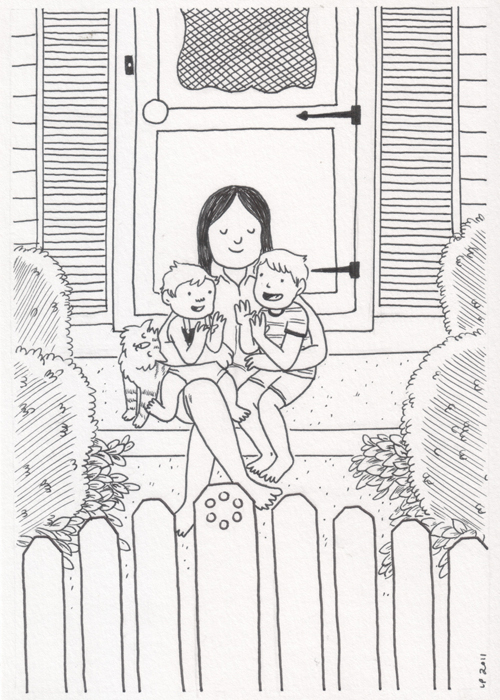
The Christmas before my Mom passed away, I gave her a framed print of the photo below. She had said it depicted one of the happiest times in her life: enjoying spending time with both sons before they got too old to hang out with Mom all the time.

Shortly after she passed, my wife Sarah contacted Liz Prince – one of my favorite cartoonists – and commissioned her to do a recreation of that photo. It turned out pretty amazing:
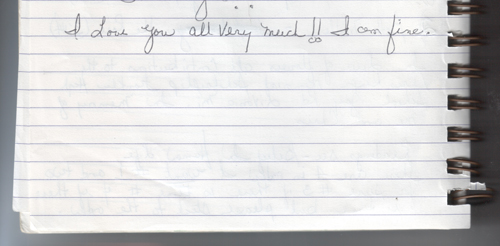
My mom was always hyper-organized about things – she had an entire notebook detailing her arrangements set aside for when the time came. I like to think that the last line in that notebook is a pretty good summary of what she would want us to remember on this anniversary.
I’m kind of amazed by how many of my Facebook connections have been sharing “Firsts” involving the Beastie Boys in the wake of Adam Yauch’s passing. Anyway, I figured I’d throw my story on the pile.
When I was seven years old, an older kid in the neighborhood turned me on to “(You Gotta) Fight for your Right (To Party)” (And also “You Give Love a Bad Name” by Bon Jovi). Somehow, on a subsequent trip to K-Mart, I talked my Mom into buying the “Licensed to Ill” LP.
As I was only seven, I was still very dependent on parental assistance when it came to actually playing records, so there wasn’t much privacy involved in the inaugaral listening. I distinctly remember dancing around in circles in the living room as side one played out, and going extra crazy as “Fight for Your Right” concluded the side. We didn’t make it to side two, but we did loop “Fight for Your Right” a few more times.
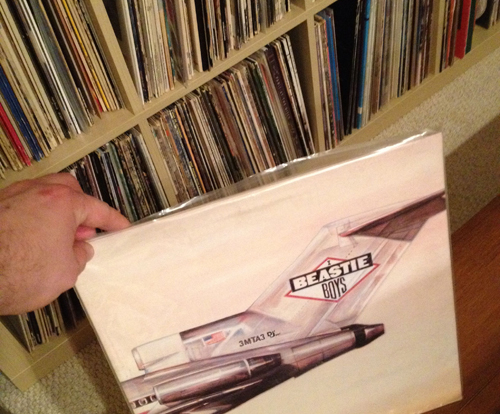
My Mom then explained that the record was a little too grown-up for me, and that she’d take me to get any different record I wanted. I agreed to this swap, but made her promise to save the record for me until I was grown-up enough (Genius move: theoretically doubling my record collection, just like that). If I recall correctly, the replacement I selected was the K.I.D.S. Incorporated Soundtrack (Hey, look! You can download it here!) – the look of disbelief on the older neighborhood kid’s face on hearing the details of this swap is another thing I remember well.
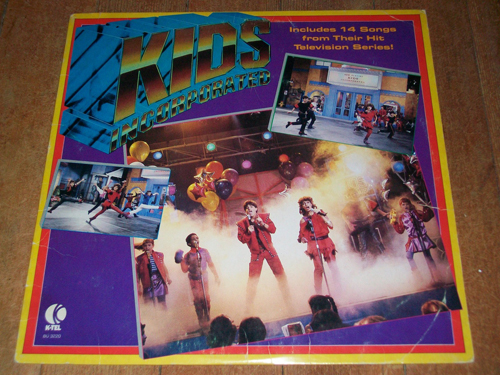
At any rate – fast forward to my impossibly awkward high school years. At this point, I had completely forgotten about the Beastie Boys record. I had also become obsessed with all kinds of weird music, and consequently obsessed with all things vinyl. One day, out of the blue, my Mom asks me: “Do you remember this?”
…and so the LP was returned to it’s true and rightful owner (Thanks, Mom!). I no longer have the K.I.D.S. Incorporated Soundtrack, but I still have “Licensed to Ill.”
Cut to today, the day that Adam Yauch lost his life to the same disease that also claimed my Mother. I pulled the record out and started playing it as I sat down to write this. After side one ended, I started to get up to go flip it over, but thought it fitting to leave it at that.
Some insane things I learned while writing this:
- Per wikipedia: “The original title for this album was “Don’t Be a Faggot,”” but Columbia Records flatly refused to release the album with this title and pressured Russell Simmons (their manager and Def Jam label head) into having the Beastie Boys come up with another name. Adam Horovitz has since apologized for the band’s earlier title.”
- At age seven, I had a mega-crush on the character “Stacy” on K.I.D.S. Incorporated. As a byproduct of googling the Soundtrack while writing this, I have discovered that “Stacy” grew up to be Fergie, of the Black Eyed Peas. Do people know this? How did I not know this until now? To be clear: I no longer have any sort of crush on Fergie.
Finally, the Onion reminds everyone: they are fast, they are ruthless.
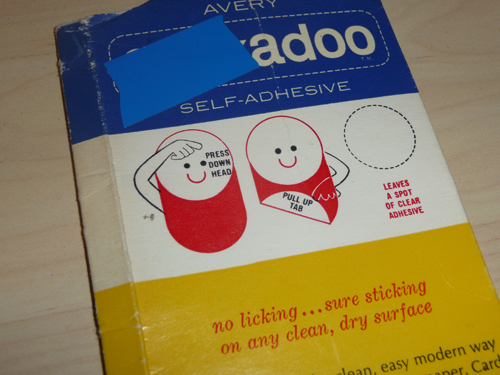
Awesome vintage office supply packaging, rescued from an estate sale by Sarah. I can find no other photographic evidence of this product on the internet. There are plenty of shady sites trying to get you to use them to register the (expired) trademark, though.
One of the best Kickstarter projects I contributed towards in 2011 (and easily the fastest to go from Kickstarter to my mailbox) was Jack Stratton’s “Funklet: Graphic notations of twenty classic funk beats.” (My full Kickstarter history is here. Looks like I’m going to be getting approximately one documentary in the mail every day in Q4 2012.)
So yes: drummers, coded music, and unwieldy and inconvenient print and recording projects, all rolled into one – there was no way I was not giving them my money. Normally, a sentence like “A funky beat is a great design” would make me want to die, but in the context of the Kickstarter pitch, I can almost not even cringe when I read it:
I want to make a book about drumming that looks good. A funky beat is a great design. Some great designers:
– Bernard Purdie
– James Gadson
– Herman Roscoe Ernerst III
– Zigaboo
– Roger Hawkins
– Clyde Stubblefield
Not long after the project was funded, I got an email with a zip file containing new recordings of 20 isolated funk beats; and shortly thereafter, the Funklet itself showed up in my Mailbox:
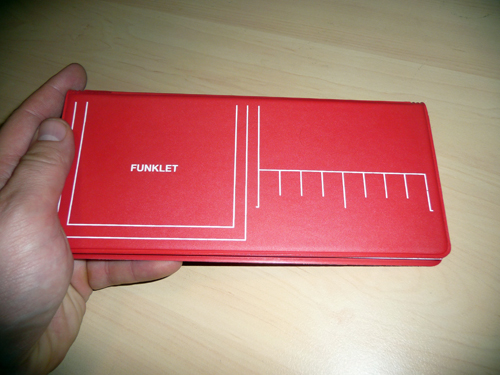
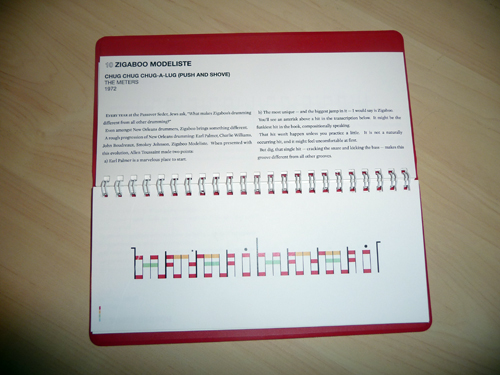
The best part: the writeups that accompany each beat are a perfect mix between informative, insightful, and hilarious: what could have been dry dissection and analysis is instead another key part of the package. Listening to the beats while reading the backstory and following along with the graphic notation was the closest thing to a “following along in the liner notes” experience I’ve ever had with an MP3.
If this seems awesome to you, you’re in luck! While the Funklet is now out of print, Stratton has encouraged his backers to pass around the PDF version, and a website presenting interactive versions of roughly half of the beats has been launched at Funklet.com. While the website doesn’t echo the “liner-note-iness” of the print version, it does allow you to slow the beat down to more readily pick it apart, which is nice.
A seemingly random byproduct of this whole project came in the eighth and final update message sent to the Funklet’s Kickstarter backers: several Bernard Purdie beats (including one transcribed in the Funklet) mashed up with Beatles songs, to create “The Funky Beatles” (It’s probably worth noting here that Purdie apparently overdubbed drums onto several Pete Best-era Beatles tracks for US release in 1964 – I didn’t know that). The full four-song playlist is here, but my favorite is “Little Something:”
Ok, that’s all. Its probably a safe bet that I will never use the word “Funk” this much ever, ever again.
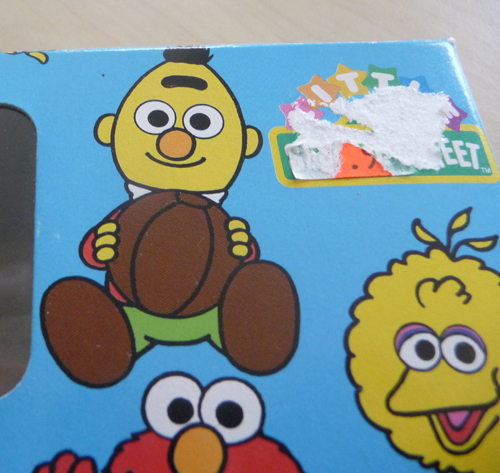
The photo below comes from the box to a Japanese “Little Sesame Street” alarm clock that my wife Sarah bought last time we were in New York (Throughout the time we’ve known each other, Sarah has intermittently used Bert and Ernie to describe how she’s feeling about situations, tasks, etc. For example, “I’m Ernie” roughly translates into “Let’s go, I can’t wait!”; whereas “I’m Bert” implies a more apprehensive, tentative demeanor).
Anyway: I just love the fact that “little” Bert is depicted as already having his signature massive unibrow. It looks like a weird, extra, upside-down mouth on his forehead.
While going through a stack of old issues of the Chicago Reader for another project, I happened upon the April 14th, 1994 issue, which featured a few selected reactions to Kurt Cobain’s then-recent suicide.
The first words in the feature come from Steve Albini, and the no-nonsense type treatment that the Reader’s designers gave to his copy seemed to match his tone perfectly. I was surprised when I googled to find that this article seemingly hasn’t made it onto the internet.
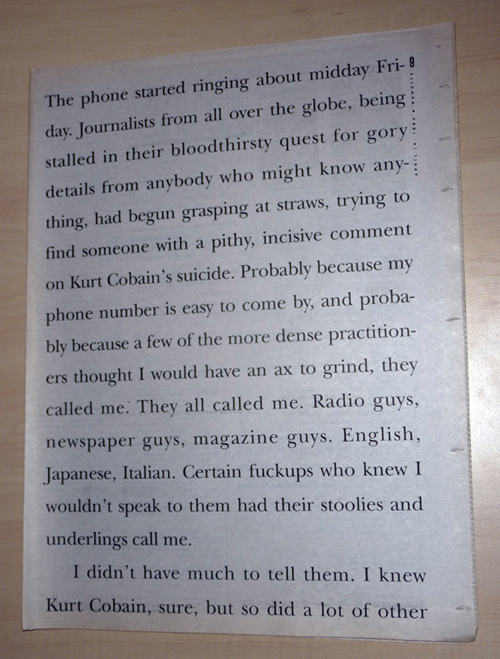
So, here it is in full: “Nevermind the Bullshit: An Outsider’s Reminiscence:”
The phone started ringing about midday Friday. Journalists from all over the globe, being stalled in their bloodthirsty quest for gory details from anybody who might know anything, had begun grasping at straws, trying to find someone with a pithy, incisive comment on Kurt Cobain’s suicide. Probably because my phone number is easy to come by, and probably because a few of the more dense practitioners thought I would have an ax to grind, they called me. They all called me. Radio guys, newspaper guys, magazine guys. English, Japanese, Italian. Certain fuckups who knew I wouldn’t speak to them had their stoolies and underlings call me.
I didn’t have much to tell them. I knew Kurt Cobain, sure, but so did a lot of other people. I wouldn’t call him a friend, but not because I didn’t like him. I met him too late in the game for a real friendship to have been possible. By then, he was already a millionaire rock star. He was surrounded by people whose status and income depended on his popularity. All of those people and more presented themselves as his friends.
He was smart enough and realistic enough to know that someone popping out from behind a bush trying to be his friend probably had an angle. He was weary from those people being his friends. Out of respect for what remained of his patience, I never pressed him for any intimacy.
My impression of him is probably as skewed as anybody else’s. I saw him during a resolute period, where he and his band were operating at capacity: productive, confident and (mostly) at ease. There were obviously episodes before then and since where things were not going so well, but I’m disinclined to speculate why. Plenty of other people who knew him less than I did will do that for you.
I was and remain an outsider to the daily goings-on within the band and in Kurt’s life, like a small child dazzled and a little frightened by a carnival, which others around him took little notice of. As an outsider. I had benefit of a neutral perspective when weird things occurred, as they do in the lives of all important people.
I realized how different their world was from mine the first day I was in the band’s company. Krist Novoselic had brought a pile of settlement papers with him from Washington for the band to sign. The settlements were for different nuisance law-suits that had sprung up like fleabites once the band became successful. Sign here, and give a few grand to someone who claims a splinter from a broken bass guitar got in his arm, requiring traumatic tweezing. Sign here, and give a house down payment to some bastard who says somebody in Nirvana was once in a band that was once in debt to him for a phone bill. Sign here, and pay off somebody for remembering that his high-school band was once named “Nirvana.” Sign here, and put some greedy bastard’s kid through military school because he wore a Nirvana T-shirt to a wake, traumatizing the guests.
The nonchalance with which these parasites were bought off, as though it were a common and insignificant chore, dumb-founded me. The band, before breakfast, had dispersed more money to liars and cheats than I would make in a year or more.
There seemed to be no end of badgering crap. Everybody, everywhere wanted a piece of them; wanted them to pony up and pay the street tax on the road to popularity. In addition to the periodic bleedings they had to endure, there was the constant intrusion of the world at large into their lives. A journalist with a chip on her shoulder had almost cost Kurt his daughter, whom he loved with more enthusiasm than any other thing. The authorities, once tipped, belligerently ignored the plight of the thousands of truly unloved and uncared for children whose parents didn’t happen to be famous, in an attempt to make an example of a nontraditional couple.
Another pair of would-be journalists (crazed groupie chicks, actually) had been hounding Kurt, his wife, and all of their friends while “researching” a “book.” Their research apparently included seducing Family members, swiping personal artifacts, and accosting them in public, in an attempt to cause a “scene.”
Traveling in rock-music circles makes dealing with death inevitable. There is a persistent and pathetic association between extremes of lifestyle, indulgence, obsession and rock music. ln the last couple years, l’ve seen a half-dozen friends and acquaintances die or pretty much so. It’s a drag, and it’s a shame, but as long as there are suckers for the myth of the outlandish rocker, there will always be people to encourage them and profit from their decline. They’re also going to die once in a while. That’s part of the myth, too.
Every thinking person has, at some point, contemplated ending his or her life. Few of us do it, but everyone can appreciate the impulse and occasionally entertain the thought. Given the magnitude of the life that was dropped in his lap, it would be pompous and naive to criticize Kurt Cobain for acting on it.
Kurt Cobain’s death was not an accident. It was a shame.
Steve Albini, a Chicago-based recording engineer, worked with Nirvana last year on its third and final studio album, “In Utero.”
I guess it’s been a lot longer than I thought since I’ve been to Toronto: I accidentally found out today that the iconic, animated neon signs of Sam the Record Man can no longer be found on Yonge street: the store closed in 2007, and the signs lit for the last time in 2008.
My next thought was: “What happened to those signs?” Thinking they may have suffered a fate similar to Ann Arbor’s recently-defunct neon landmark, I did some googling and found the following at Wikipedia:
On May 30, 2007, supporters started a Facebook group to save the store’s neon spinning record signs titled “Save the Sam’s Sign!!!”; the group, and its attached online petition, garnered more than 18,000 members. On June 14, 2007, it was announced that the sign, and the contents of the store would be auctioned-off by Benaco Sales on June 27. However, on June 22, 2007, the Toronto city council voted in favour of designating the entire property as a heritage site, protecting the entire building, including the landmark signs. The entire building was designated because the Ontario Heritage Act has no provisions to protect store signs.
On January 18, 2008, Ryerson University officially acquired the property for future expansion of its nearby campus.
On October 4 [2008], the iconic neon signs were lit for the last time as part of Toronto’s Nuit Blanche festivities. The removal of the signage commenced shortly after the final lighting, and by mid March 2009 the building had been partially demolished.
Further searching reveals that Ryerson University was expected to put the sign back up at some point, but no one seems to be in any hurry to do that:
In 2008, a local newspaper reported that the signs, “gently removed and documented like artifacts from an archaeological excavation”… will be “refurbished and put into the new building.”
Ryerson appears to have changed its mind since then. Wednesday as he unveiled the design of Ryerson’s new $112 million student learning centre on the Sam’s site, the school’s president, Sheldon Levy, told me that, “when we took down the records, we had negotiated with the city that they can appear on one of the buildings. They are going up high on the existing library,” he said, pointing to Jorgensen Hall, which is next to the new centre. But Craig Dykers, the architect at Snohetta, the Norwegian firm that won a competition to design the new building, had a different answer when I asked him about the Sam’s records.“We know that it’s a protected piece and we should find a home for it,” he said. “Ryerson is going to form a committee to find a home.” Janet Mowat, a spokeswoman for Ryerson, said that the signs are resting off campus, in a warehouse “somewhere in the GTA.”
Time will tell where Sam’s Records will end up, but for now, here’s a video of the last lighting of the original sign: