Page 90 of 99

Rebel Rebel Records, Saturday night, Bleeker St. in NYC.

     Enter: 40-ish man who looks like a suburban high school teacher. Not dorky enough for math or science, possibly social studies. Also: Could play ‘The Father’ on a prime-time drama. He quickly gathers a stack of ‘dance’ vinyl and asks the clerk to play it over the house system so he can decide what to buy.

     Enter: Wyclef lookalike – Identical hairstyle, different features. Not Wyclef. Dressed in expensive everything. Suit, shoes watch etc. BLING.

     5 minutes pass. The clerk continues to preview dance records by playing 10 seconds, lifting the needle, advancing it 30% of the way in, and repeating, so that each side of a 12″ takes about 30 seconds to ‘hear.’ The difference between the three needle drops on each side is often one added looped instrument. [If that’s the way you guys pick your songs, you deserve all the morons who say ‘Oonce Oonce’ when you tell them you ‘spin.’]

     Wyclef lookalike begins pointing at the clerk and yelling ‘I want that record!’ after hearing 3 seconds of each song. EVERY song. The best part is he never LOOKS at the clerk, just stares intently at the vinyl he’s flipping through and occasionally emphatically points over his shoulder and yells ‘I want that record!’.

     Clerk attempts to explain that he is playing the records for someone else to decide on. Wyclef pays no attention and continues furiously flipping and demanding records.

     5 minutes pass. Wyclef finishes his vinyl flipping and approaches clerk.

     They begin to discuss the fact that he can have the records if Social Studies Dad doesn’t want them. Wyclef elects to wait until Social Studies Dad has made his final selection, so he engages clerk in dialogue about a record he’s looking for. Apparently it’s a Felix Da Housecat Remix of a song featuring Peaches and Iggy Pop.

     Social Studies Dad’s ears perk up.

     “Iggy and Peaches? That song’s called ‘Kick It.’

     Wyclef turns to look at Social Studies Dad. Beat. Bad Fake New York Guy Vinyl Knowledge Pissing Contest Accepted.

     (Condescendingly) “No no no , they did three songs at that session – Rockstar, Kick It, and Motor Inn. I’m looking for The Felix mix of Motor Inn.” (To clerk, chuckling in a ‘Woe is me and my CRAAAZY vinyl’ sort of way) “I’ve been how far now? OHIO looking for this thing.”

     “And this isn’t even the original track, this is a Felix Da Housecat remix?”

     Nods, Serious look. They lock eyes.

     “Interesting.”

     Beat, both look away.

     Wyclef Begins Pressuring Social Studies Dad for his records. I leave.

Three crazy Japanese things

1.) Absolutely Insane Japanese Television Show

     ….which is about as redundant as an ‘orange orange,’ but I digress. I found this link last summer and misplaced it until now, so it might be old news. It’s a great site recounting the events of Japanese reality-show ‘Nasubi.’ The show is named after its lone contestant:

     “When he arrived at the apartment, he was shown a stand full of magazines, a huge pile of postcards, and told to strip naked. The room was empty except for a cushion, a table, a small radio, a telephone, some notebooks, and a few pens. There was not a crumb of food, a square of toilet paper, or any form of entertainment. Whatever he needed, he was to win by sending thousands of postcards into contests. The producers left and Nasubi was on his own in his unique survival challenge.”

     The site goes on to describe the events of the year Nasubi spent trying to reach his goal of one million yen worth of prizes. Some Highlights:

     “Nasubi won his first contest on February 8th. He got some jelly, a 1560 yen value, leaving him with 998 440 yen left to win. That day, he ate food for the first time in two weeks! On February 22nd, he won a 5 kg bag of rice. Unfortunately, he had no cooking utensils. At first he tried eating it raw, but eventually devised a cooking method where he put it in an empty can beside a burner for an hour until it was “cooked”. He ate about a half cup of rice a day using two pens for chopsticks.”

     “A doctor’s visit in May, after five months in the room, revealed Nasubi to be in perfect health! No scurvy, no fleas or lice, and no signs of malnutrition. He had lost a lot of weight, and his ribs were showing through his skin, but his blood tests and a physical examination revealed no other problems. His fingernails had grown to several inches long and his hair and beard were getting rather unmanageable by that time, but they were annoyances rather than dangers.”

     “When he won a video deck to go with his TV, he was able to watch his two videos–an exercise video and a cycling tape. He saw a woman for the first time in 10 months. In November, he won two rolls of toilet paper, a huge moment in his life! He also won a Sony Play Station, which went well with the train driving game, and special controller he had won earlier and he spent hours in front of the TV. He spent about three days playing with it and then decided that he was wasting too much time playing with it.”

     You should really read the whole thing. It’s seriously INSANE. After the summary, the author of the site reflects on reality television in japan:

     “So what was the point of the Nasubi experiment? Ostensibly, it was to test the thesis that contests had become so ubiquitous that it would be possible to live entirely on what one had won in them. This was called kensho seikatsu (Living off contests).

     Of course the real reason is that programs involving human suffering are extremely popular in Japan. The gambaru genre, started in the 1980’s with the immensely popular show Za Gaman, a show in which university students competed in contests to see who could stand the most pain, eat the most unpleasant foods, and perform the most humiliating tasks. Denpa Shonen is a logical continuation of this trend, and the stunts are becoming more and more dangerous/appalling.”

     The official (japanese) Nasubi website is here. What I don’t understand is how they got him to mug for the camera all the time. The Nasubi link came from this site, which features all sorts of strange japanese shows, such as ‘Namidame (Tear-Filled Eyes):’

     “Namidame is a show about crying. In the words of the show’s creators, “The tears of the Japanese are fine. Therefore, let’s cry together. As much as possible, let’s cry, and face front, and work. Namidame is a program which delivers impression to you.” Airing at 11:55 every Wednesday night on TV Tokyo (Monday on TV Osaka), this program’s most popular segment is called “Namidame Battle Royale” in which ten young women compete to see who can cry the most in a contest to win one million yen. They keep the women up in a house over a period of one week, give them two test-tubes to collect their tear drops in, and leave them to cry their eyes out. Techniques include insulting one another and slapping each other in the face, drinking a lot of water so that they would be able to cry well, sitting in front of a fan, and claustrophobic girls locking themselves in closets. Every day the girl who is in last place is eliminated and when the competition really starts to heat up, the girls do things like going to the local video store and renting every copy of Titanic so that the other girls will have nothing to cry over. Just one of these girls has enough neuroses to keep a team of psychologists busy for decades and watching them cry over comic books and sappy love songs or playing bizarre emotional game is as disturbing as it is funny.”

2.) Japanese Jessica Rabbit

     Another thing I found last summer and forgot about: This Japanese singer has adopted the identity of Jessica Rabbit from ‘Who Framed Roger Rabbit.’ Fair enough.

Twins

3.) Shadowsuits

     I thought EVERYONE had seen these shadowsuit clips, but I was talking to someone yesterday who had no idea what I was talking about, so I’m posting them here. In case you didn’t see them, they’re clips of people interacting with other people wearing all black so that they blend in to the background. This allows all sorts of crazy real-time fake ‘camera tricks.’ It’s like a fake fake-out – you’re so used to the camera tricks that it’s weird to see things happen in obviously unedited real time. If you haven’t already seen these, I suggest you watch them at least twice so you figure out what’s going on. The ping pong clip got all the press (link, link, link. One of those is bound to work), but there’s also a basketball one (link).

     They’re both from a show called Kasoh Taikai:

     “Kasoh Taikai (Masquerade Contest) is a wonderful show. They have it about 2 or 3 times a year, always with the same beloved old comedian (sort of Milton Berle-ish) as the MC. All the contestants are amateurs — families, or school classes, or housewives, etc. They think of something to imitate, using their bodies mostly and homemade improvised costumes. Some are horrible and some are quite fantastic, but all are unexpected and inventive. After each act, the audience (or judges? I forget) evaluates them and the really bad ones are bong-ed out (a big carnival gong is used, with each vote making it go higher). There are about 20 acts in each program, and at the end big prizes are awarded to some of the un-bonged ones. “

     The official Kasoh Taikai site has a video page and images of all sorts of crazy shodowsuit antics. If anyone knows of a way to see a full episode of the show, I’m ALL ABOUT IT.

Vinyl Data

One strategy that major record companies have been employing lately to deter downloading is adding bonus computer content to new CD releases. I recently discovered that this technique is not unique to CD’s, but had in fact been practiced in the vinyl era as well. That’s right: there were a handful of records released in the late 70’s and early 80’s that contained computer programs as part of the audio. This is totally insane, and totally great.

Most of these programs were written for the Sinclair Spectrum home computer series. The Sinclair Spectrum was a relatively cheap home computer system that used a television set as a monitor and loaded programs from tapes. It thrived in England in the early 80’s:

     “If the PC is the great electronic product of the 1990’s, the Sinclair Spectrum was the great electronic product of the 1980’s. The Sinclair ZX Spectrum (nicknamed the Speccy) was invented by Sir Clive Sinclair, a British Inventor.”

In the case of these programs on vinyl, the user would have to play back the proper portion of the record, record the resultant chatter to tape, and load the tape into the spectrum. Some users have mentioned playing certain games so much that they could recognise the loading sounds.

Photo by Iñaki Quenerapú

The Spectrum is emulated, so you can download the data files and an emulator and view the programs / play these games. Failing that, you can play most of these games directly in your browser (provided you have java enabled). All of the data files are available in the archive at worldofspectrum.org, and there are tons of emulators available for both the PC and mac (I used Spectaculator for Windows and Fuse for OS X).

The most ordinary of these vinyl-encoded programs are purely informational. Inner City Unit, a spinoff from Hawkwind, released an album called ‘New Anatomy’ in 1984. The last song on side two – ‘Hectic Electric’ consists of the audio pulses of a program that can be recorded to cassette and loaded into a 48k Sinclair Spectrum. When run, the program reportedly displays “a comprehensive description of the band, their recordings and tour schedules, etc.” I was unable to find this program data online, but the track has been included on the CD reissue.
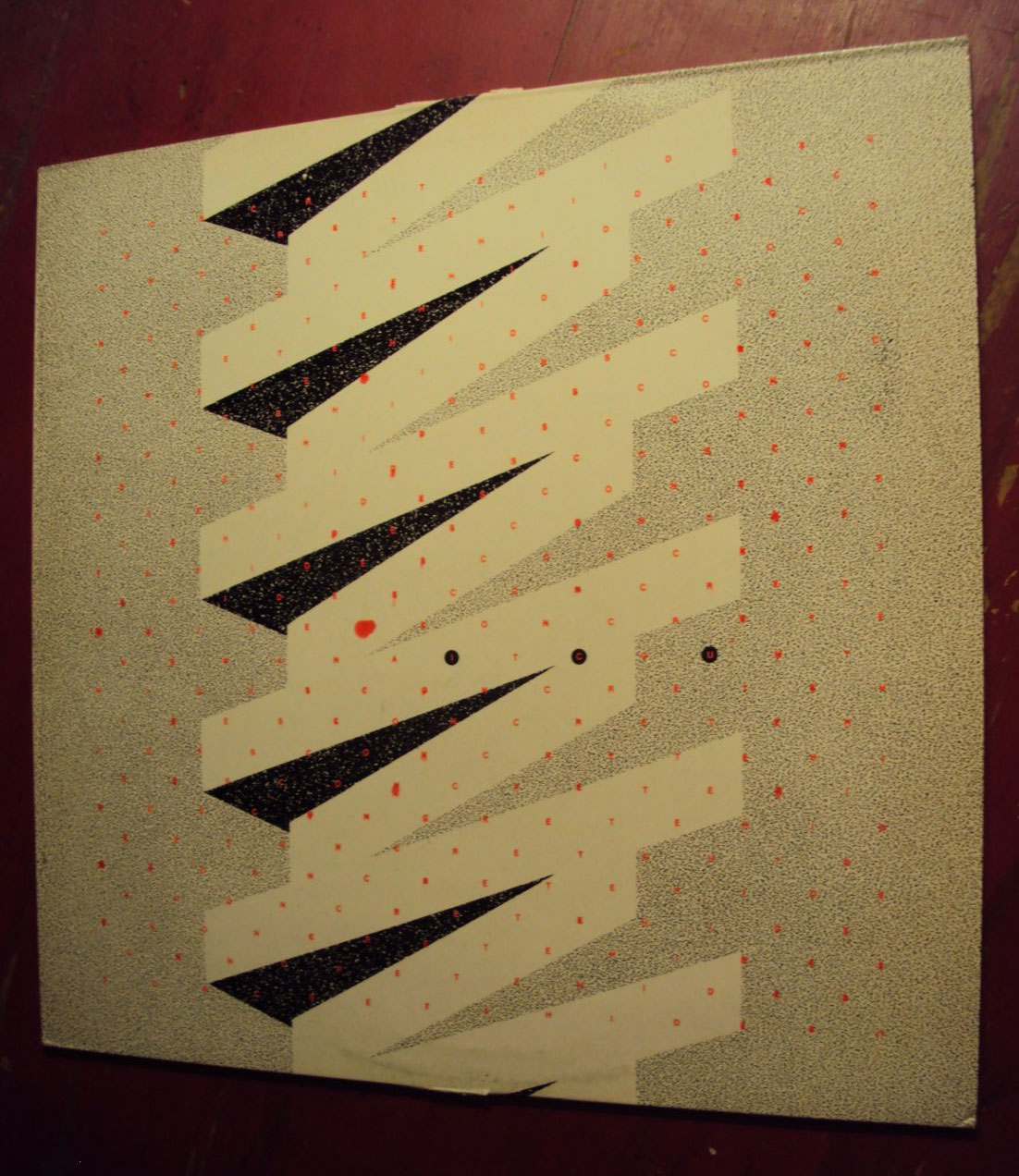
Nik Turner's Inner City Unit - 'New Anatomy'

Similar, though slightly more involved was a program included on a record called ‘XL-1’ by Pete Shelly, former leader of The Buzzcocks, in 1983. The last song on the record – ‘ZX Spectrum Code’ – contains the audio pulses of a computer program for the Sinclair ZX Spectrum. Again, the technically savvy listener was expected to copy the audio to tape and “play” it to their home computer. When properly input, the program was to be run while listening to the rest of the album.

Pete Shelley - 'XL-1'

If all of the above was executed properly, the program displayed rudimentary graphics and printed lyrics in time with the music for the duration of the album. Only the U.K. pressings of the album have this track. There’s a silent lockgroove before ‘ZX Spectrum Code’ so you can’t play it by accident (and deafen yourself). I’ve only found mention of one poor soul who has claimed to have successfully accomplished this feat – they mentioned it tangentially in a newgroup posting. If you have any further information, please contact me.

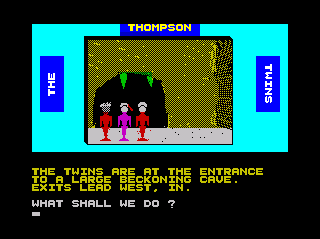
A gigantic step up from encoded text files were actual games included in the grooves of records. In 1984, The Thompson Twins released ‘The Thompson Twins Adventure Game’ in both regular vinyl and flexi disc formats.
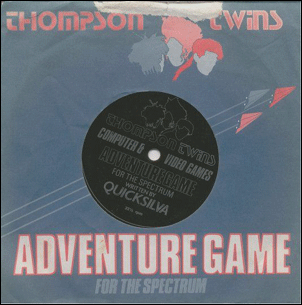
Twins

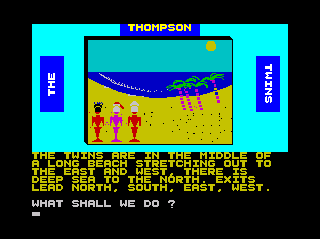
This one has survived the ravages of time and is available for download online. You can play it in your web browser by clicking this link. The game is a bizarre text-based adventure in which you guide the Thompson Twins around a land of beaches and caves. If you didn’t grow up playing these games, in which you have to keep a map on paper and guess which key verbs the programmers used for certain actions, you may find it a bit frustrating. I poked around a little, but I haven’t played it enough to see how it ends. If you go north from the first screen, the Thompson Twins drown en masse. As always, the British say it best:

     “And, what a surprise, having deafened my family recording it onto tape on our dodgy stereo, when the game finally worked, it was crap. Bloody stupid Eighties floppy haired inumerate Chesterfield talentless ponces.”
Twins
Twins

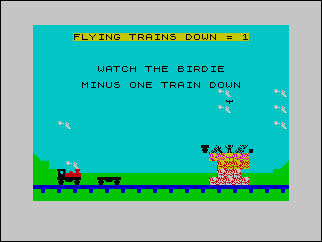
Another spectrum game included on vinyl was found on the B-side of Chris Sievey’s ‘Camouflage’ 7″ single. The game is called ‘Flying Train’ and was coded by Sievey himself. It’s a pretty horrible game, notable only for the explosions, which throw a stickfigure engineer from the wreckage of the train.
Twins

You can download ‘Flying Train’ here, or play the game in your browser by clicking this link. Note that the instructions will ask you to hit ‘Cyan’ to begin, and no matter what you hit you’ll get an error. I’ve found that hitting the ‘C’ key three or four times at that point gets you by to a screen where you enter your last name, and you can proceed from there.

So who was this guy who wrote computer game B-sides to his pop singles? Chris Sievey led 80’s new wave popsters The Freshies. According to one newsgroup poster, “the most interesting fact (possibly the only interesting fact) about The Freshies is that all their instruments and equipment were painted pink. This is true.”

Twins

This history of the Freshies, from the liner notes of their greatest hits album is an
entertaining read. They had mild success with one single: “I’m In Love With The Girl At The Manchester Virgin Megastore Checkout Desk” (which later had its name changed to “I’m In Love With The Girl At A Certain Manchester Megastore Checkout Desk”).

     “Sievey and Ryan approached the one record company not to be featured in Sievey’s expanding rejection folder, MCA. A licensing deal was swiftly completed, and ‘I’m In Love With The Girl On The Manchester Virgin Megastore Check Out Desk’ spent a solid thirteen weeks on the Radio One playlist, remaining stubbornly in position throughout the heavily enladen Christmas chart and selling
over 40,000 copies. With dark and cruel irony however, a postal strike prevented the chart return statistics from the north of England from
reaching the central computing heart of London. Despite this agonisingly frustrating setback (The Freshies really wouldn’t have been The Freshies without being constantly blighted by such surreal slabs of plain bad luck), the band remained on stand-by, literally, with all the equipment stacked in the back of a Transit van for Top Of The Pops on three separate occasions, while the single bobbed and dipped with infuriating uncertainty.”

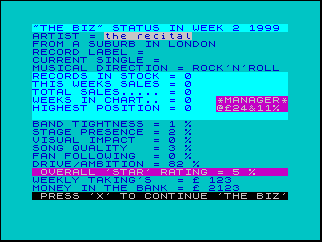
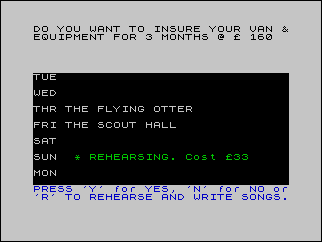
“I’m In Love With The Girl At The Manchester Virgin Megastore Checkout Desk” ended up on a soundtrack cassette to a Spectrum game called ‘The Biz’. This game wasn’t included on a vinyl release, but it too was coded by none other than Chris Sievey, and can easily be seen as a sort of venting of his frustrations with the music industry.

The player inputs information such as name, band name, class, and hometown to begin the game. From then on, the ‘band’ is offered a dizzying array of options, all affecting variables used to determine your ‘Overall Star Rating.’ Players must schedule each week’s shows and rehearsals; hire managers; record, press and market singles; film videos; and pay attention to what genres the kids are buying on the weekly charts. I ended up playing it for way too long when I ‘tried it out.’ You can download ‘The Biz’ here, or play the game in your browser by clicking this link.
Twins
Twins

Sievey ended up making a living wearing a paper mache head, playing a character called Frank Sidebottom. Frank Sidebottom was originally conceived by Sievey as the Freshies’ number one fan, but he soon grew to be infamous in his own right (Or so I’m told, I’d never heard of him). He’s apparently released albums under the name, and become something of a celebrity soccer (football) fan.

Twins

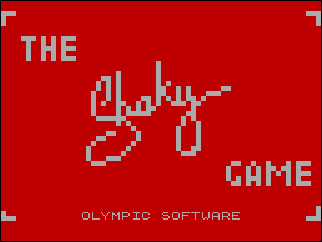
Rockabilly revivalist Shakin’ Stevens – one of the best-selling artists in Europe in the late ’80s – also had a Spectrum game included on a vinyl release. ‘The Shaky Game’ is variously reported to have been included as the B-side of the ‘This Ole House’ single, and at the end of side 2 of “The Bop Won’t Stop” album, possibly both.
Twins

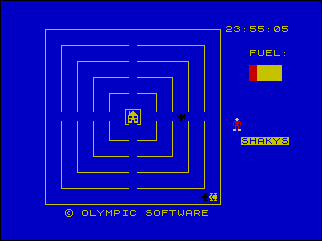
The program audio is preceeded by a message from Shakin’ Stevens himself, explaining the concept to less computer literate fans. The goal of ‘The Shaky Game’ is to drive Shakin’ Stevens’ car to the center of a maze while avoiding bats, who bite you.
Twins
Twins

You can download ‘The Shaky Game’ here, or play it in your browser by clicking this link.

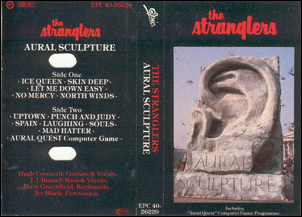
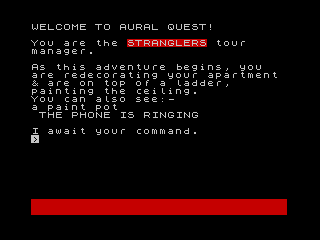
Though not released on Vinyl, the cassette version of The Stranglers’ ‘Aural Sculpture’ album included the audio pulses of a game called ‘Aural Quest.’ The game, a text adventure in which you controlled the band’s tour manager, was written by their Keyboard
player, Dave Greenfield.
Twins

From the newsgroups:

     “Sorry, Mr. Greenfield, if you read this, but it’s true..the game’s so bad I took my copy of Aural Sculpture back to the shop to exchange for the version without the game on the end of the tape (which they had to order specially!)..it just wasn’t worth the aggro of falling to sleep with the tape on and being woken by a Spectrum 48k loading noise!”
Twins

You can download the file here or play it in your browser by clicking this link. There’s a walkthrough here.

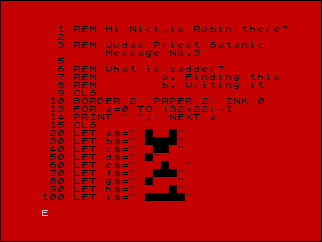
There’s a bit of Spectrum audio code in the song ‘Thank You’ on Scottish band Urusei Yatsura‘s ‘Everybody Loves Urusei Yatsura’ album, released on their own Oni records. Successfully importing the code produces a program that, when run, displays the following screen:

Twins

Examining the source for the program reveals the following comments:

“Hi Nick, is Robin there?”

“Judas Priest Satanic Message #3”

“What is sadder: a.) finding this b.) writing it”
Twins

You can download the file here.

The last song on side two of ‘Peace and Love Inc’ by 80’s synth popsters Information Society is an approximately three minute long modem transmission.

Information Society - 'Peace and Love, INC'

The title of the song – ‘300bps N, 8, 1 (Terminal Mode or ASCII Download)’ – gives all necessary information for importing the message. The message revealed upon playing the transmission into a properly configured computer is:

     “SO WE’RE SUPPOSED TO PLAY IN CURITIBA IN 18 HOURS, BUT OUR BUS IS BEING HELD HOSTAGE BY THE LOCAL PROMOTERS. THEY’VE FORMED SOME UNHOLY ALLIANCE WITH THE BRAZILIAN COUNTERPART OF ASCAP; THE PRS. APPARANTLY THE PRS HAS THE LEGAL POWER TO ARREST PEOPLE, AND THEY WANT A PIECE OF THE NATIONAL TOUR PROMOTER’S MONEY. THE LOCAL SECURITY FORCE, “GANG MEXICANA”, HAS BEEN BOUGHT OUT FOR 1800 CRUZADOS AND A CARTON OF MARLBOROS EACH. THE ONLY FACTION STILL OPERATING IN OUR DEFENSE IN “BIG JOHN”, OUR PERSONAL SECURITY MAN, AND HE’S HIDING IN HIS ROOM BECAUSE A LOCAL GANG IS OUT FOR HIS BLOOD BECAUSE OF A 1982 KNIFING INCIDENT IN WHICH HE WAS INVOLVED. OUR 345-POUND ROAD MANAGER, RICK ONLY HAD THIS TO SAY: “YOU WANTED THE LIFE OF A ROCK STAR!”. PAUL, JIM AND I REALIZED THAT THIS WAS ONE SITUATION WE WERE GOING TO HAVE TO GET OUT OF OURSELVES.

WE CONVENED A HASTY CONFERENCE IN THE NOVOTEL LOBBY. PAUL SUGGESTED CONTACTING OUR NATIONAL TOUR PROMOTER IN SAO PAULO, BUT WE REMEMBERED THAT HE WAS IN RECIFE WITH FAITH NO MORE, WHO HAD JUST ARRIVED FOR THEIR BRAZILIAN TOUR. WE THOUGHT ABOUT CONTACTING OUR BRAZILIAN RECORD COMPANY IN RIO, BUT THEY WEREN’T HOME. OUR EVER-DILIGENT AMERICAN MANAGER WAS ARRANGING HELP OF NUMEROUS FORMS, BUT HE WAS IN NEW YORK, AND JUST TOO FAR AWAY TO GET ANYTHING MOVING IN TIME.

AND THERE WERE 6000 KIDS IN CURITIBA WHO JUST WOULDN’T UNDERSTAND.

WE KNEW IT WAS TIME FOR ACTION. PAUL WENT UP TO THE PRS GUYS AND INVITED THEM INTO THE BAR TO DISCUSS IT LIKE CIVILIZED MEN OVER A FEW BRAZILIAN DRINKS, OFFERING EACH OF THEM A CIGAR ON HIS WAY. THE AMUSED PRS HEAVIES SEEMED
TO LIKE THE IDEA OF A FEW FREE DRINKS, EVEN IF THEY KNEW THEY WOULD NEVER GIVE US OUR BUS BACK. WHEN PAUL WINKED AT JIM AND I ON HIS WAY IN, WE WENT INTO ACTION.

I STOLE OFF TO MY ROOM TO PREPARE WHILE JIM WENT INTO ACTION. CREEPING CAREFULLY THROUGH A SERVICE DUCT, HE MANAGED TO GAIN A VANTAGE POINT SOME THREE METERS ABOVE THE BUS, AND DROPPED CAREFULLY ONTO THE ROOF. AFTER USING HIS ALL-PURPOSE SWISS ARMY KNIFE (AFFECTIONATELY KNOWN AS THE “SKIT KNIFE”) TO JIMMY OPEN THE ROOF HATCH, HE WENT THROUGH THE DARKENED INSIDE OF THE BUS AND REMOVED THE INSIDE ENGINE SERVICE PANEL. USING SOME SPARE ELECTRONIC PARTS HE FOUND WHILE ON AN ISLAND IN THE AMAZON, HE WIRED THE ENTIRE BUS FOR REMOTE CONTROL, NOT UNLIKE A REMOTE CONTROL TOY CAR.

AT THIS POINT, HE ASKED HIMSELF “NOW HOW SHALL I GET OUT OF HERE?!?”

PAUL WAS HAVING DIFFICULTIES OF HIS OWN.

“COULDN’T YOU SEE YOUR WAY CLEAR TO LETTING US FULFILL OUR CONTRACTUAL OBLIGATIONS IN CURITIBA? THINK OF THE KIDS!”

THROUGH OUR TRANSLATOR, FABIO, THE PRS MAN, ALDO, SAID:

“NO. YOU AMERICANS THINK YOU OWN THE WORLD. HAH! WE’LL BURN DOWN OUR RAIN FOREST IF WE DAMN WELL PLEASE. WE NEED ROOM FOR COWS!! WE WANT A MACDONALD’S ON EVERY… OH, SORRY, YES ANYWAY, NO. WE NEED 40% OF YOUR CONCERT
RECEIPTS TO GIVE TO DAVID BOWIE.” HE SAID, WINKING TO THE LOCAL PROMOTER, PHILLIPE.

AS PAUL CONTINUED THIS ELABORATE DISTRACTION, JIM EFFECTED AN ESCAPE FROM THE HEAVILY GUARDED BUS BY CRAWLING DOWN INTO THE CARGO BAY, CUTTING A HOLE IN THE FLOOR WITH THE SWISS ARMY KNIFE’S ARC-WELDER, SLIPPING INTO THE MANHOLE COVER SITUATED UNDER THE BUS, AND WALKING UP INTO THE HOTEL’S BASEMENT FROM THERE. JIM CALLED UP TO ME IN MY ROOM AND GAVE THE SIGNAL. WE WERE NOW TO MEET AT THE BACK ENTRANCE, WITH OUR TECH GUYS. BUT FIRST, PAUL WOULD NEED SOME HELP GETTING AWAY FROM HIS UNWELCOME GUESTS, AS THINGS WERE GETTING UGLY.

“HE SAYS HE HAS LOST HIS PATIENCE, AND THAT HE CAN THINK OF OTHER WAYS OF EXACTING PAYMENT FROM YOU KURT AND JIM PHYSICALLY.” OUR TREMBLING INTERPRETER SAID.

THE MOMENT HAD COME. JIM BEGAN OPERATING THE BUS FROM HIS BACK ENTRANCE VANTAGE POINT. AS THE REMOTE-CONTROLLED BUS LURCHED TOWARDS THE PARKING LOT EXIT, THE SUPERSTITIOUS SECURITY YOUTHS FLED IN TERROR. PAUL WAS PULLING ANXIOUSLY ON HIS COLLAR AS THE PRS MAN BEGAN DESCRIBING HIS COLLECTION OF WORLD WAR II NAZI CERIMONIAL KNIVES WHEN A SUDDEN CRASH SPLIT THE TABLEAU.

JIM HAD PURCHASED ME THE GIFT OF A COMPLETE BLACK NINJA STEALTH ASSASSIN OUTFIT IN ARACAJU. I HAD BEEN GEARING UP AND CRAWLING THROUGH THE AIR CONDITIONING DUCTS ALL THIS TIME. AS I CRASHED THROUGH THE CHEAP IMITAION-STYROFOAM HUNG CEILING TILES, SKATES FIRST, I FLASHED NINJA STARS ALL ABOUT ME. IN THE ENSUING PANIC, PAUL ESCAPED TO THE PRE-ARRANGED BUS PICK-UP POINT. UNFORTUNATLEY, MY SKATES WERE A POOR CHOICE OF FOOT GEAR FOR ESCAPING OVER THE BROKEN GLASS. OF THE TABLE I HAD LANDED ON. WERE IT NOT FOR THE CONFUSION AND THE NINJA-STAR-INFLICTED WOUNDS DELIVERED TO THE BAD GUYS, I WOULD HAVE BEEN SET UPON WHILE FOUNDERING ON THE GLASS-STREWN CARPET. AS IT HAPPENED, HOWEVER, I LEAPT THROUGH THE OPEN DOOR OF THE CAREENING BUS AS IT DEPARTED THE CITY OF MARINGA FOREVER.

IF ONLY WE HAD MANAGED TO GET OUR EQUIPMENT IN THE BUS, TOO . . .

EVERY WORD OF THIS STORY IS TRUE.

– KURT HARLAND

Japanese composer and synthesizer expert Isao Tomita released an LP called ‘The Bermuda Triangle’ on RCA records in 1979. A paragraph on the sleeve says “Each side of this Lp contains coded data in the form of sound effects. The message can be recovered if the electrical signal from the Lp is interfaced with the input of a micro computer programmed to the Tarbel system.” I found the decoded messages on Tomita’s site:

Side A: “THIS IS THE BERMUDA TRIANGLE, OVER. SLOW DOWN. TARGET 50 MILES OFF SOUTH FLORIDA, A GIANT PYRAMID AT OCEAN BOTTOM.”

Isao Tomita - 'The Bermuda Triangle'

Side B: “THIS IS THE BERMUDA TRIANGLE, OVER. LOOK OUT! THE CYLINDRICAL OBJECT JUST LIKE THE ONE EXPLODED OVER SIBERIA AND CRASHED INTO TUNGUSKA IN 1908, HAS JUST COME INTO THE SOLAR SYSTEM.”

Amazing. Tomita appends the following comments to his notes on the ‘Bermuda Triangle’ album:

     “Ocean explorers have found scientific evidence that a collosal pyramind – more immense than any other known – sits beneath the sea in the Devil’s Triangle. Sonar tracing reveals massive and symmetrical structure. Says author Charles Berlitz: “I believe we have found a pyramid where Atlantis may have existed!”. Pyramid as shown in artist’s sketch is in 1,200 feet of water and reaches incredible height of 780 feet. Undersea researcher found it 50 miles off South Florida.”

A few others that I haven’t found many details on:

  • A Space Invaders clone on the B-side of the ‘Google’ single by Atomic Robo Kid. ‘
  • Polish group Papa Dance released a 12″ called ‘Ponizej krytyki’ in 1987. It contained a program in two parts. The program was info about the group and some kind of quiz.
  • “Carter USM put a program at the start of a song on thier “101 Damnations” album. ‘A Perfect Day to Drop the Bomb’. It starts with about 15 seconds worth of loading screeches. It’s just code, though (the blue and yellow bit), with no header, so you can’t load it in, unless you know what you’re doing.”

Other Articles in this ‘Series:’

The Unrelated Thoughts of Monday

     Do you by chance remember that game where
you make your thumb and pointer finger into a sort of pseudo-circle and
hold your hand below waist level, and if someone looks, you get to sock
them in the arm? I was trying to explain this to two people yesterday
and they had never heard of it, and thought I was insane. I vaguely remember there being a word
you were supposed to say as you were punching their shoulder. Anyone?

     I, like many Americans, have seen ads for the Karaoke Revolution video game on television. What I want to know is – does it actually measure pitch with that microphone? That would be really, really great and actually useful if it measured pitch. For some reason I suspect that it doesn’t. My guess is that it just measures when you start and stop a word, and matches it up to the lyrics. Otherwise it would be way too frustrating for the tone-deaf children of America. Has anyone played it? Do I need to do some investigative journalism and RENT it?

     Everytime I stumble across something in another language, someone tells me to ‘babelfish it,’ implying that this should be an easy thing to do, like ‘googling it.’ I always go to babelfish.com, and they always ask me for money to perform their translation services. This leaves me feeling dumb. Today I ‘googled’ babelfish and realized that I AM a moron, and should have been using babelfish.ORG all along. Unfortunately, the thing I was trying to translate today was in Polish, and babelfish.org doesn’t appear to offer polish. If you were, say, researching an obscure dance 12″ that was released in poland in the 80’s and needed to translate a few key newsgroup postings from polish into english, then HAVE I GOT THE SITE FOR YOU! Here it is: Poltran!

     I finally listened to that New Trans-Am
record (‘Liberation‘) that everyone is being all opinionated about, and
was amazed that I haven’t read a single article that calls them out on
‘biting’ from Warp records’ ‘Bushwacked’ mp3’s. The links on the Warp site are dead now, but the mp3’s can
still be found here and here. The
second is the better of the two. Compare to ‘Uninvited guest’ from
Liberation, which consists of the same idea over a bad midi track.
Good times. I’ve never been a big fan of Trans Am – their presentation
has always seemed like gimmicky posturing to me – but that doesn’t
mean the album is without inspired moments – the tuned speech of an
anonymous weatherman on ‘White Rhino’ is pretty well executed. I could
have, however, done without the spoken ‘Fuck This, My White Rhino’
refrain.

     Back before the Shins’ ‘Chutes
Too Narrow
‘ came out, I remember hearing that they were working on a documentary on
the making of the album. Anyone know what happened to this? I see
there was once an ~ 8 Mb video file on their official site called ‘Recording
in the basement,’ but the link is dead now.

     Also: I decided that if I ever start a restaurant it will be called ‘St. Dinner.’ Not sure why, I just like that.

Dream Job: Pinball Design

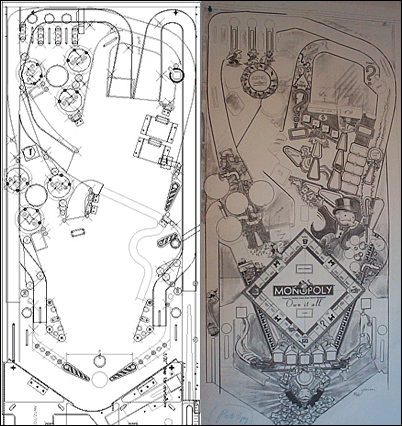
     For awhile there, no one was making pinball machines. Thankfully, Stern has once again started cranking ’em out. For their (relatively) recent ‘Monopoly’ machine (as seen at the Lager House in Detroit), they contracted Pat Lawlor, famous among really cool dudes for his design of the Addams Family Pinball Machine (Highest-selling pinball machine ever). He’s posted an amazing step by step walkthrough of the planning, design, prototyping, testing, and production process for the Monopoly Pinball Machine. Highly recommended reading.

Calling all nerds!

Oh, inverted grooves!

     Response to the vinyl manufacturing saga thus far, from Sarah:

“Get a room, man! ENOUGH’S ENOUGH.”

With that in mind, I present yet another installment.

     Another fun trick that can be employed while cutting the master
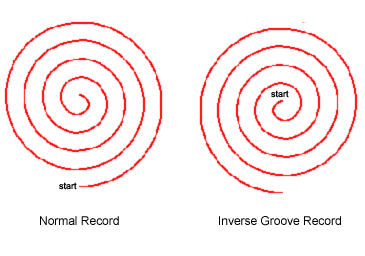
plates for a vinyl release is the inverted groove – that is, a record that plays from the inside out. Since the direction in which a standard turntable ‘turns’ to plays a record is not reversible (Without human intervention), the direction of the grooves is reversed.

Inverse!

     This practice appears to have practical origins in radio and soundtrack applications. Radioarchives.org is a site dedicated to preserving first generation copies (ie vinyl) of early radio programming. Some choice bits in the way of explanation from their site:

     “During the golden age of radio, programs were generally recorded on 16″ disks. Some were recorded during a live broadcast; others were pre-recorded for distribution to local stations. Since the concept of repeating a recorded broadcast didn’t really take hold until the early 1950s, many of these recordings were not retained once they had been played for reference purposes.”

     Apparently inside-out records used to be common for radio shows distributed on 16″ vinyl, as many are labeled “start outside” or “start inside”. Some theories on why this was done, culled from the newsgroups:

     “I would guess that it is easier to
cue;
you drop the needle into the wide band in the middle rather than a thin
strip
on the
edge. Also, it would be easier to watch for the end of the record.”

     Records with inverse grooves were also used to accompany silent films. Details from this newsgroup thread:

     “Yesterday, I went to a movie at one of the few remaining old-time
movie
houses, you know, the kind with only one screen with a curtain, a
marquee
over the entrance, and a bubble-like ticket window on the outside.

     Anyway, inside the theater, they had some display cases containing old
cinema artifacts. One of these was a 15-inch record that was used as a
soundtrack to a 1920s movie — not a movie soundtrack in today’s sense
(e.g. “I got the soundtrack to Titanic”), but the actual audio
component to
a movie being played. This was how it was done in the days before sound
was encoded on the film itself, and yes, sometimes the record got
annoyingly out-of-step with the film.

     I took a close look at this ancient record, and I noticed that there
was no
spiral on the lead-in area. Rather, there appeared to a single
lock-groove
around the perimeter. Then upon looking at the lead-out area, not only
did
the penultimate groove come to an abrupt tapered end, but the word START
was carved on the vinyl at that point. It therefore appeared that the
record was designed to play backwards, or from the inside out.

     Were inside-out records common back then, for that or other purposes? I
did hear that there are a number of novelty records being made that way
today, but with caution that they wreak havoc on modern tracking
systems.
Could one reason for using inside-out records in movies be that, with
the
assumption that outer tracks sound better than inner tracks, it saves
the
best quality sound for last?”

     The only reply that this post garnered was the following:

     “Sixteen-inch transcriptions were done in the days before hot-stylus
cutting, so audio that was crisp and clear at the edge of a 33 1/3 rpm
record would become muddy and muffled near the label. Therefore,
transcriptions were usually done alternating outside-in for side 1,
inside-out for side 2, outside-in for side 3, etc. This meant that the
sound quality would change gradually over a 30 minute cycle, rather
than a
jarring difference every 15 minutes when the record sides switched.”

     “Another reason for inside-out records was that they required less
babysitting while being cut. The chip cut from a lacquer has a tendancy
to
drift towards the center. If the record runs from the outside in, the
operator has to sit there and constantly brush the chip away from the
approaching cutting stylus. If it’s cut inside out, the cutting stylus
is
moving away from the chip, and the operator has one less thing to worry
about.”

     “In the ’50s, hot-stylus cutting and chip suction came along and made
both
of these issues moot points. Of course, they came with their own set of
problems, but that’s a different story…”

     There are a few contemporary releases I’ve managed to track down that use this technique, though many of them are no less obscure than the transcription records.

  • Blur’s promo-only 10″ version of ‘Tender.’ Adding to confusion is the fact that there were two promo 10″ versions of Tender – one with backwards grooves and one that came sealed in a silver bag.
  • Certain pressings of Throbbing Gristle’s ‘The Second Annual Report’ have one side that plays backwards.
  • The Checkpoint Charlie ‘Salz & Phiffer’ EP, which is actually by Mark Volman and Howard Kaylan (AKA Flo and Eddie, formerly of The Turtles) has inverted grooves, with a warning on the
    cover in both German and English “Warnung: Diese Platte ist nur von innen nach aussen Abspielbar” and “Warning: This record plays inside out!”
  • In 1979 Mercury Records released a sampler called ‘Counterrevolutionary Music: 33 1/3,’ including songs from the Scorpions, John Cougar, and others.
  • From a techno newsgroup: “On Circuit Breaker’s – “Experiments in Sound”-EP one side runs on 45 completely backwards (“When this song ends, so will your needle”) and the other side, which runs on 33, has two tracks. The outer track runs “forwards”, the inner one “backwards”, so both stop in the middle (Not in the centre of the record, but the middle of the playable vinyl area; if you had two needles, they would run
    towards
    each other). They did the same thing
    with their “Overkill/Frenzy” single. It’s a bitch to
    figure out which one is which when you’re spinning in the dark.”
  • Certain pressings of Megadeth’s Sweating Bullets 12″ single were pressed on baby blue vinyl that plays backwards.

HELLO ME! MEET THE REAL ME!

     There are also countless hardcore bands who have done this on one 7″ or another, but all the imformation I’ve turned up using google has been pretty vague. If you know of one, let me know.

     Also: ‘Inverted Groove’ would be a good name for a funk band.

Mixed bag of questions and unrelated statements

knock knock!

     I’ve been collecting these little wind-up automatic instrument-player guys called ‘Knockman Family’ since I recieved two of them as christmas gifts. From left to right in the photo above is the ‘Banjo player,’ who actually strums his three tunable strings; the ‘drummer,’ who beats on his own head; the cymbal guy, who hops up and down hitting his cymbals together; the ‘weird ridged fish’ player, who turns in circles, causing a marble to make ‘weird ridged fish’ noises; and the ‘xylophone’ guy, who does a sort of hula, causing the mallet to hit the tuned tines in his stomach. I did a bit of research into the design team behind them, Maywa Denki, and found that they’ve released several books that deal very specifically with things that I’m way into, and which I’d be very interested in owning. The problem is, the entire site is in japanese, and there doesn’t appear to be a way to order these books. I’m hoping someone might know of a place that deals with import books? Or maybe can tell me what the Japanese on the books page or any of the individual book pages says (The only English says ‘Please crick each book.’)? I don’t know. The main store site is here. Any suggestions are welcome. I tried going through
thier distribution company, Cube, but they only carry bizarre, inexplicable toys, no books.

     Several years back I almost bought a Beatles-related CD that I’ve now forgotten the name of. I’m hoping someone might remember it. Supposedly George Martin assembled a group of the best ‘soundalikes’ for each of the original Beatles, had them learn an album’s worth of Lennon / McCartney compositions that The Beatles never put to tape, and then recorded the whole mess on vintage gear at Abbey Road. I’ve always regretted passing it up the one time I saw it for sale, simply because I’m curious as to how closely they came to replicating the sound. If you know what I’m talking about, please let me know.

     In my previous post about Emitt Rhodes, I mentioned an interview in the current issue of Scram Magazine. Well, I finally received my copy, and here are two things I’ve learned about Emitt Rhodes:

1.) He’s TOTALLY INSANE:

Q: What other instruments do you play besides guitar, piano, bass and drums?
A: Nothing. Is there anything? For me it’s 1-4-5. For me it’s Pythagorean Theorum. It’s mathematics. I love Pythagorus. Everyone else in rock n’ roll loves Pythagorus too, even if they don’t know it. I’m just telling you that Pythagorus was a wonderful guy. He lived a long time ago. Nobody knows him and nobody cares.

He proceeds to mention Pythagorus twice more during the interview.

2.) He’s not very tactful, or ‘P.C.’ for that matter:

Q: What was it like working with Curt Boettcher in the studio?

A: Well, Curt Boettcher was a gay guy!

Q: Yeah, but what was he like?

A: He was just gay.

Q: He liked those high-pitched vocals, a lot of harmonies….

A: Yeah, he wanted to fuck me in the butt.

Q: …well that was awkward.

A: No, it’s just not what I do. (laughs)

Q: Did you make music with Curt?

A: Yeah, I kinda wrote music. And I’m sorry Curt, but my butt is my territory.

Q: So Keith Olsen was more the guy that you…

A: Yeah, Keith Olsen was the straight of the two. I like Curt Boettcher, but I’m just not gay.

     Not a terribly endearing interview. His first record is still ridiculously good, though.

     A long time ago I posted asking for any weird variations of the birthday song that you might know of. This one recently came to my attention. The end of line three is supposed to represent ‘you folks.’ Sickening.

“Hippo, Birdie, Two Ewes,
Hippo, Birdie, Two Ewes,
Hippo, Birdie, Deer, Ewe, Fox,
Hippo, Birdie, Two Ewes!”

This was recently sent via my mail form:

“Iwant to tolkomg about peace and love”

…and 3 minutes later:

“Can wee tolking about peaca and love”

No one ever includes a return address when they use that form.

Also:

  • Chris Graves of humorous bassist fame recommended an application called ‘WWW File Share Pro,’ which makes sharing files ridiculously easy. You simply choose which folders to share and it serves up a right-click-save-as-able html listing that anyone can pull up via your IP address.
  • I’ve been alerted to the existence of a New Pornographers B-SIde – ‘Turn,’ which was apparently only available on the Japanese release of ‘Electric Version.’ Anyone out there have an mp3 of this?
  • It ocurred to me a few minutes ago that big awards shows usually do those retrospectives honoring nominee’s who’ve passed away over the year since the last broadcast. Did anyone see if Eliott Smith was mentioned during the Oscars? Or do you have to win to be included?
  • Finally, I know that there’s got to be some way to get around ‘authenticating’ WinXP. I just haven’t found it yet…

Haircut

     I got my hair cut awhile back. The person who cut my hair was using english in the ‘I barely know what I’m saying, my inflection is all off’ sort of way. Which is fine. Three highlights from my haircutter person’s mouth to you.

  • “ShampooEyebrow?”
  • “Keep’EmLose’EmSideburn?”
  • “I Show Style. I Show Style.”

Alarm clocks

     I’ve had the same alarm clock since I was 14, so I’m in the bad habit of ignoring the alarm completely. My first solution was to have the radio turn on at full volume when the alarm went off, but pretty soon I was able to sleep through this, too. Nowadays, to ensure that I get up on time, I set my alarm clock AND the alarm on my cell-phone, and stagger the snoozes by 5 minutes. The result is a relentless alarm-fest for about a half-hour before I finally drag myself out of bed.

     Similarly, a friend of mine was once in the habit of plugging a shopvac into one of those wall-socket timers because he had grown immune to the sound of his alarm clock. He would set the power switch of the shopvac to ‘on,’ plug it into the timed outlet, and set the timer to turn on whenever he needed to be up. Impossible to ignore.

     Another friend recently alerted me to the existance of ‘Shake Awake:’ a device that goes under your pillow
and vibrates at gradually increasing intensity at a set time. The Shake Awake website says:

     “A Better Way To Greet The Day! This travel-sized alarm clock fits neatly under a pillow or mattress and its gentle vibrations will jar the deepest sleeper from their slumber. Great for: The “Morning Impaired,” Hearing Impaired Sleepmates on Different Schedules, Busy Travelers, College Roommates, Snoozing Commuters, and Sleepy-Headed Teens.”

Yeahhhh Boy.

     The dilligent internet enthusiast has probably already seen the recently released Flavor Flav alarm clock, but I include it here to be thorough. The point of all this is that for some reason, I get the impression that there are some ridiculous alarm clock tales out there. I could be totally wrong, but If you do have something to add, either let me know or post in the comments.

Lock Grooves

     I’ve been writing about interesting vinyl manufacturing anomolies for the past few days. Tuesday I covered Flexo Records and flexidiscs, and yesterday I wrote about parallel grooves. Today’s bit is about ‘Lock grooves:’ grooves that feed back into themselves so that they repeat indefinately. You should probably read all of these entries because I hear that’s what the ladies are looking for these days: men with EXTENSIVE knowledge of obscure vinyl manufacturing practices.

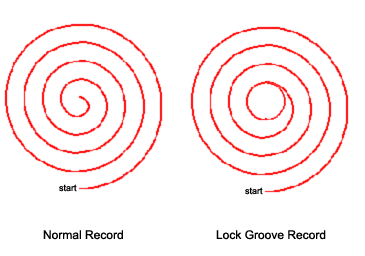
     Records with lockgrooves are cut like any other record until the beginning of the loop is reached. At this point, instead of spiraling inward, the radius of the groove becomes fixed, producing a perfectly circular loop that ends where it began.

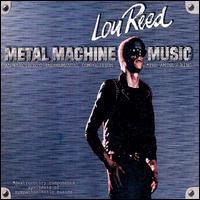
     The most familiar example of this amongst record collecter types is Lou Reed’s infamous ‘Metal Machine Music.’ Recorded as a ‘Fuck You’ to Reed’s record label, the album is often described as ‘Unlistenable.’ The AMG review sums up the sentiment nicely:

“One would be hard-pressed to name a major artist who ever released an album as thoroughly alienating as Lou Reed’s Metal Machine Music.”

MMM!

     The the end of side four is a lock groove that extends the cacaphony to a length only limited by the listener. Reed himself has said of the album: “Well, anyone who gets to side four is dumber than I am.”

     Given the Monty Python troupe’s previous history with clever vinyl mastering, it should come as no surprise that
they’ve already covered this territory:

     “…on another Monty Python record, the Pirannha Bros. sketch at the end of one side finished with a lockgroove of “Sorry squire, I scratched the record I scratched the record I scratched the record… ad infinitum (or the next power cut). Hours of fun.”

     The album in question appears to be ‘Another Monty Python Record,’ but I haven’t yet confirmed this.

     A few ‘serious’ artists have used a final lockgroove to include jokes, and in the case of English band Heaven 17, a perpetual pun. The final track on their ‘Penthouse & Pavement’ album – ‘We’re Going
to Live for a Very Long Time’ – builds to a never-ending groove repeating the phrase ‘For a very long time.’ The James Gang’s “Yer Album” features messages in the lockgrooves that end each side. At the end of side one, the lockgroove repeats “turn me over, turn me over, turn
me over…”; and on side two it plays “play me again, play me again, play me
again…”.

A LONG TIME!
Yer Album

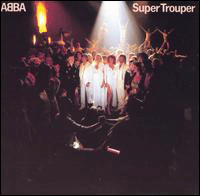
     Other artists have used the repetition of a lockgroove loop to exaggerate the duration of certain sounds. At the end of side two of Abba’s ‘Super Trouper,’ after the final song – “Like Old Friends Do” – the audience’s applause continues into a locked groove (From a NG posting on the topic: “Wow, must have been a
great performance, they’re giving them a neverending standing ovation…”). Side two of Pink Floyd’s ‘Atom Heart Mother’ ends with ‘Alan’s Psychedelic
Breakfast,’ and the dripping tap continues until you lift the needle.

Abba Old Pink

     Of note to crazy record collector types is
“Loop,” a flexidisc by the Velvet Underground which was included in the December 1966 issue of Aspen Magazine (Edited by Andy Warhol). Details, from a VU discography site:

     “Loop is the B-side. The label says “Guitar and feedback”, “First half of a 15-minute recording made with two monaural tape recorders” and “Final groove purposely left open”. The credits went to John Cale who is supposedly the only person playing on Loop. The flexi has a closed-groove ending so the last groove repeats itself ad infinitum.”

VU

     Moving beyond the novelty of the loop, some artists have creatively used lockgrooves to hide extra tracks, creating a ‘false ending’ to the record before the hidden track’s grooves. The listener could hear the ‘hidden’ music only by manually placing the needle beyond the lock groove. This technique was used on the Pale Saints’ “Half-Life” 12,” which had a lock-groove after the second song on the second side, ‘hiding’ an unlisted third song; and in similar fashion on the split 12″ by Nurse With Wound / Sol Invictus / Current 93.

     The 1968 Moby Grape album ‘WOW’ has a lockgroove that seperates the song “Just Like Gene Autry: A Foxtrot,” which unlike the rest of the album, is mastered at 78 RPM. The track is also said to be ‘mixed to sound like an old 78.’

Moby Grape, dude.

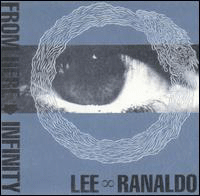
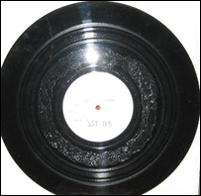
     My interest in lockgrooves has led me to do something I NEVER would have guessed I’d ever do: I got into an eBay bidding war over a Lee Ranaldo record. Ranaldo’s 1987 SST release ‘From Here to Infinity’ consists entirely of songs that end in lock grooves. Each song builds to a perpetual 2-second loop which continues until you get up and advance to the next track manually. In the middle of one side is an etching of a flaming serpent chasing its tail around the record. Apparently SST also released this on CD, which seems to defeat the purpose. At any rate, I lost the auction, so if a vinyl copy pops up on eBay again anytime soon you’re not allowed to bid against me, I hereby decree.

Moby Grape, dude.
FLAMING SERPENT

     A legend amongst lockgroove enthusiasts is Boyd Rice, an avant garde electronic experimentalist who is “notable for being one of the first avant-garde rock artists to use turntables in his work,” according to his AMG bio. He records under the name ‘Non,’ and his most influential work appears to be 1978’s ‘Pagan Muzak.’

Pagan Poetry

     Mute Records reissued ‘Pagan Music’ at some point, and they’ve got a great article on the album here:

     “Pagan Muzak is a 7″ vinyl long playing record housed in a 12” sleeve. It consists of 17 locked/looped grooves, each of them containing a different noise. A second axis hole drilled off-centre doubles the number of tracks; and as it can be played back at up to four speeds – 16, 33, 45 or 78rpm – working out just how many tracks Pagan Muzak effectively offers the listener involves complicated calculations of all the different playback combinations of axis choice, turntable speeds and the grooves themselves. The mind boggles, yet when it was sold as a long playing record, some buyers thought they’d been short-changed by at least five inches. Boyd recalls, “Because it came out as a 7″ record in an album sleeve, people used to go,[in a whining voice] ‘It says LP on here. . .’ ‘Well,’ I said, ‘LP means long player, and this is the longest player you are ever going to find’.”

     “Between the record’s peculiar format and the noises contained in its locked grooves, Pagan Muzak clearly anticipated the sound and shape of many music practices to come. Rice’s radicalisation of vinyl reversed the listener’s usual passive relationship with the record as a sound carrier. To listen to it meant first of all making ‘musical’ choices regarding pitch and tempo, dependent on playback axis and turntable speed. In this sense, putting on Pagan Muzak was a kind of rehearsal of a near future, when DJs and turntablists would play records as a musical instrument.”

     “Getting the idea was the relatively easy part. Getting the record manufactured presented a formidable logistical challenge. Boyd continues, “Well, because they always lock off a groove at the end of a record, it seemed reasonable to me that they would be able to do it at any mastering plant. But everyone I spoke to said, ‘No, you can’t do this, it’s impossible, the technology doesn’t exist’. Then these people in Virginia said, ‘Oh yeah, we should be able to do that, I don’t see why not’. But a couple of months later the tapes came back with a letter saying it is not possible. Finally I went to this mastering plant in LA, and talked to its president, and he said, ‘Well, yeah, I think we could do that’. He kind of took it on as a personal challenge and did it himself. . . Always go to the top!”

     Rice has also released the ‘Rangnock Rune’ 12″, with four locked groves
and and etching on orange/reddish vinyl. Other career highlights include 1984’s ‘Easy Listening for the Hard of Hearing,’ an album of percussion sounds produced by everyday objects. Mute maintains a fairly comprehensive Non page with a discography. It’s worth noting that a history of questionable politics has marred his reputation. The AMG bio touches on some of these unflattering associations:

     “His career moved towards a bizarre mix of a cocktail lounge sounds, avant garde noise, and misanthropic folk music as it went along, bringing him a mild cult audience. But anti-Jewish and anti-Christian statements that sprung from his association with a cult and his friendship with Charlie Manson did severe damage to any momentum his career could have had and left him fairly obscure by the mid-90’s.”

     There are several newsgroup threads discussing his various ambiguous political connections. Most of the information is pretty vague, but there are threads here, here, and here.

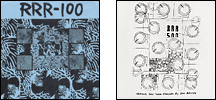
     The taj mahals of lockgroove ridiculousness are the RRR 100 and RRR 500 compilations, a 7″ and 12″ consisting of nothing but lock grooves by various artists. RRR 100 was released first and contains, as the title suggests, 100 lock grooves – 50 to a side. The RRR 500 LP features a ridiculous 250 lock grooves per side, each running 1 to 2 seconds. A good thread on the staggering impracticality of the LP is here:

RRR!

Sean Casey: “quick question about these locked groove records:
i assume you have to pick up the needle to get to
the next groove, right? but with 500 people, how
do you tell one groove from the next? are the
grooves spaced out more than on a normal record?”

‘Skincrime’: “Let’s see, we’ve got 33 1/3 RPM multiplied by 20 Minutes (say for an average LP
side, could be alot more, or less……) and we get 666 grooves, so, the
grooves are a SLIGHT bit further apart then on a Normal record……
As far as FINDING a particular groove that you want to listen to…….well,
have fun………”

Erik Hoffman: “I have a Technics 1200 turntable and it just so happens that when I lift
the stylus arm and then put it back down it advances one groove. Of
course if I wanted to listen to lock groove # 224 I would have to do
this 223 times!! This was not a problem with the 100 lock groove 7″. I
can’t imagine doing this witht the LP.”

‘Voice & Salt’: “A nice side effect of the fact it’s difficult to find a particular groove
is that they’re anonymous — oh well, I guess we’ll just have to listen
(over and over and over again….)

     A second pressing of RRR 500 is available here from forced exposure.

     Blake Edwards, the man behind recording project Vertonen released a 7″ called ‘Lock Up‘ in the early 90’s. The A-side consists of 15 lock grooves. Blake has posted the story of his experience getting the 7″ pressed on his own, and it’s an interesting read if you’re into that end of music production / label business. There are few bits about the nature of manufacturing lock grooves within the epic tale:

Vert

     “…when the lock groove locks, you usually get a click. However, some of the loops I recorded were single pitch loops, so when the groove locked there was a fuzzy pitch shift. Not heinous, but somewhat annoying nonetheless. There was nothing I could do about it anyway, since apparently that’s just the nature of the beast of lock grooves.”

     Also: ‘The Lock Grooves’ is a good name for a funk band.